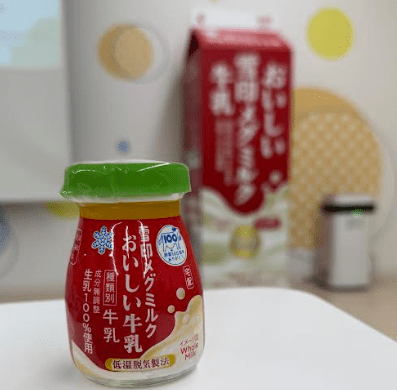
MegMilk’s Production Plant:
On May 9th, 2025 I got the pleasure of getting a deeper look into Japan’s dairy industry and some of the culture that surrounds it. While dairy was not always a staple in the Japanese diet (taking until around the 6th century to be popularized), it has largely taken off being paired with staples such as matcha lattes, sweet toppings for coffee jelly and much more! During my excursions I was able to tour one of the production facilities for a national brand called MegMilk, they produce a variety of products from cheese to milk to yoghurt and even fruit juices; I was able to sample their whole milk along with a strawberry yoghurt. After that, to finish off the day, a few of my fellow classmates, Professor Ito and Sora, travelled to the Milk Stand in the Akihabara Train Station.
Pictured above is MegMilk’s Whole milk product, its flavor was extremely rich and had quality that milk in America truly does lack. Its texture was much thicker than what I am used to and is very similar to the taste of European milk.
While a bit literal, the best way I could describe it is having more of a ‘real’ taste and feeling. It was less watery feeling and I look forward to having many more glasses!
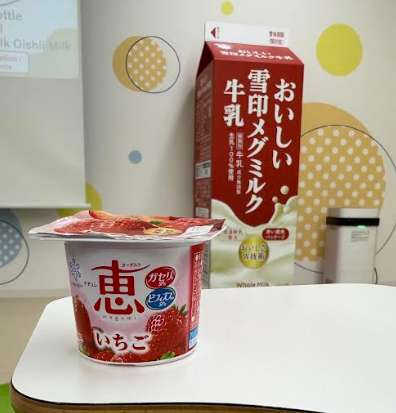
Pictured above is the Strawberry Yoghurt, while very good I felt this was more similar to what I am used to when it comes to non-greek yoghurts. It’s texture was very smooth and creamy with bits of macerated strawberry speckled throughout the treat. One neat feature not featured in the picture was a foldable spoon included in the package, it was a flat piece of card stock with tactical perforations which then allowed to be easily folded into an eco-friendly solution for spoon-less consumers!
Interview With Alex:
One of my classmates Alex accompanied me in the excursion of MegMilk’s production facility and shared many common sentiments. The first thought that came to mind for him was how clean and efficient the milk production process was. It’s very reminiscent to how many parts of Japan’s processes are extremely polished. Another part he commented on was that even though there was a language barrier with the tour guide, he was extremely welcoming and made the tour as interactive as he could. As for the product tasting, he shared how the milk tasted very similar to Bulgarian milk with its richer flavor and thicker consistency; the product was similar to the Italian and French milk I have tried previously. Moving onto the yoghurt, he commented on how it was waterier than American yoghurt which is something I didn’t pick up on at first but notice after his mentioning. We discussed and came to the conclusion that it’s probably because they use less preservatives and thickening agents that many American products are filled with.
The Akihabara Milk Stand:
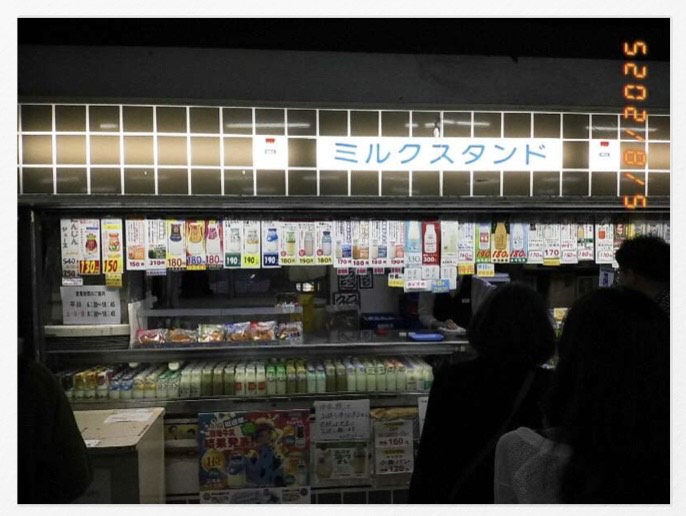
After a long day of travelling around the production facility, our TA Sora suggested going to this famous Milk Stand in the Akihabara Train Station where we could sample a flight of different Milks from across all of Japan. From there I tried 3 distinct milks, I sampled a milk produced in Tokyo, Hokkaido and a Fruit flavored milk. Each of these had their own unique flavors and qualities.
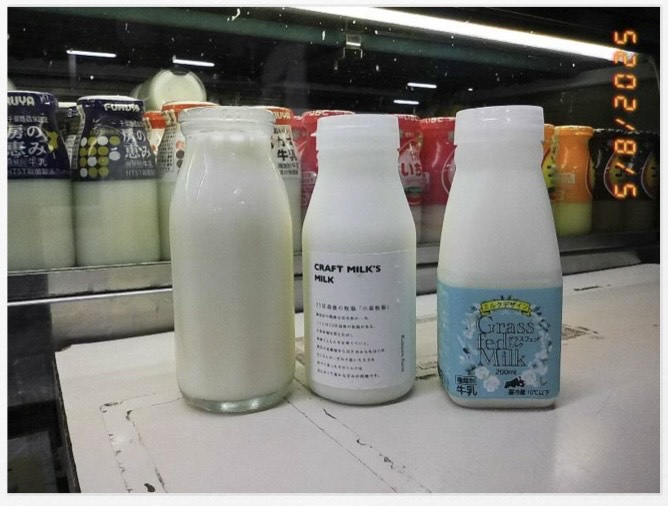
Pictured left to right, we have the Fruit Milk, Tokyo milk and Hokkaido milk. Out of these, the fruit milk was my favorite but the Hokkaido variant was definitely the most unique. The fruit milk was a thicker consistency and tasted of a melody of fruits that all blended seamlessly together; while its harmony was wonderful it made it difficult to identify any one fruit. I tasted notes of orange, mango and apple that all had a deliciously sweet taste on the pallet.
The Tokyo milk was next and was very similar to the one sampled during the MegMilk tour. The Tokyo one was Professor Ito’s favorite and I can see why, its profile was very rich and creamy with a natural essence to it. While I had originally planned to save one to drink after the Onsen last night, all three were drunk before I even realized!
Lastly, we had the Hokkaido milk which was unlike any other dairy drink I’ve had. Texturally, it was similar to others having a smooth finish and an almost cream like texture. But the taste– the taste is where it differed. It was very complex having an almost mild vanilla flavor along with some hints of nuttiness on top. While I may not get to go to Hokkaido this time in Japan, I hope to visit there someday so I can invest in more of their dairy products!


 Japanese Food Bites: Indulging in the Taste of Summer
Leave a reply to Summer Lam Cancel reply